
Meeting between the partners responsible for the Mar Chica and Mar Menor lagoons
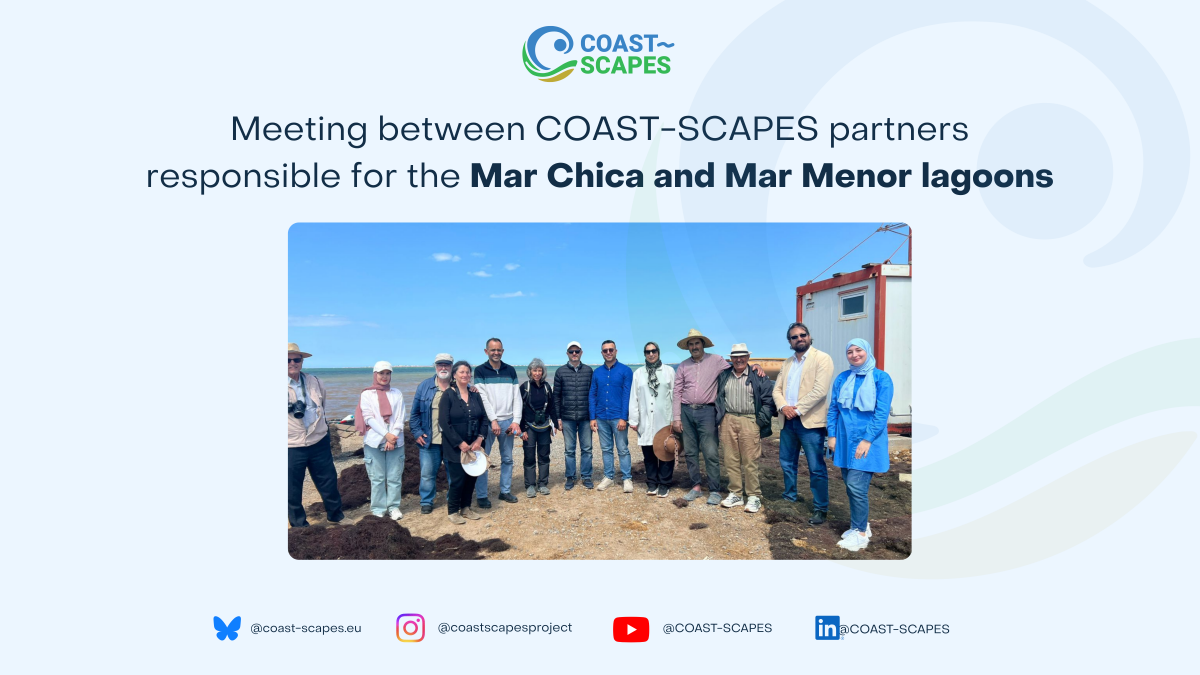
The New Water Culture Foundation (FNCA, Murcia, Spain) was hosted by the Laboratory for the Observation of the Mar Chica Lagoon (OLMAR-Lab), from the Multidisciplinary Faculty of Nador (Mohamed I University, Morocco), during the first week of May 2026. Within the framework of the COAST-SCAPES project, both entities are responsible for the Mar Menor and the Marchica lagoons. The purpose of the visit was to foster the exchange of knowledge and experiences and to explore future collaborations.
In COAST-SCAPES, the Mar Menor and the Marchica lagoons constitute the core pilot and transfer pilot case studies, respectively. Thus, in the Mar Menor, resilience solutions will be designed and evaluated to address climate change and other pressures affecting both the lagoon and the coastal area, while in the Marchica, the scalability of the methodologies developed in the Mar Menor will be explored.
During the FNCA visit, a workshop for knowledge and experience exchange took place at the Faculty of Nador, also attended by local managers. Several conferences were held to identify the shared aspects of both coastal lagoons, the initiatives and measures underway or planned and the main management mistakes made in the Mar Menor, with the aim of preventing the Marchica lagoon from following the same path.
Furthermore, during the field trip to the Marchica lagoon the following day, offered by OLMAR to the FNCA, the Bocana was visited, the mouth of an open channel to increase the renewal of water from the Mediterranean Sea into the lagoon to reduce eutrophication. There, it was highlighted that the importance of addressing environmental problems lies in tackling their root causes rather than just mitigating their impacts. A preventive approach, for example, improving the management in the basin, seeks to improve the effectiveness of solutions, promote cost-effective measures, and achieve long-term results. The tour included other points of interest, such as a visit to an ornithological observatory created during the restoration of a former wastewater treatment plant and to two facilities dedicated to the cultivation of green and red algae. These crops offer the added value that, in addition to producing fertilizers and agar-agar, allow for the lagoon’s extraction of nutrients (nitrogen and phosphorus) and pollutants (such as heavy metals, which are subsequently removed during algae processing). In the days leading up to and following the meeting with the OLMAR-Lab, the FNCA conducted additional field visits, exploring the area of influence in the Marchica lagoon, from Cap de Tres Forques in the north to the Moulouya River mouth in the southeast, including Mount Gourougou and the Moulouya River dam inland.
The initiative facilitated knowledge exchange and strengthened collaboration between the two COAST-SCAPES partners (the FNCA and Mohammed I University of Morocco). Furthermore, and most importantly, these sessions created a forum for researchers and local managers in the Marchica Lagoon to meet, fostering further understanding and future coordination.


